Greek psychological language acts like a scaffold. It becomes like a framework that allows new insights built without erasing what came before.
Revisiting Greek origins helps us:
- Separate original meaning from historical misuse
- Recover nuance that was lost
- Humanize conditions that were once stigmatized
Etymology becomes a form of ethical repair.
Human inner life changes more slowly than our tools for studying it.
Brains, cultures, and societies evolve—but fear, desire, grief, joy, meaning, and suffering remain recognizably human across millennia.
Greek psychological terms persist because they described the intersection of:
- Philosophy
- Medicine
- Ethics
- Lived experience
They named patterns that still appear in therapy rooms, relationships, dreams, and crises today.
The Ancient Greeks believed that human thought does not originate in an isolated self. Thought arises through participation in language, relationship, memory, and shared structures of meaning. The Greek idea of self is not the source of thought, but the site where thought appears.
The idea that the mind is relational, participatory, and dialogical is older than some modern notions. It clashes against the ideology of an autonomous, self-contained thinker.
Greek Psychological Terms
Here are 25 terms from ancient Greek psychological culture. They have been supporting and affecting the way we think about our own minds. This is a curated list of Greek psychological terms related to thought, emotion, and personality. Each entry includes the original Greek word with its phonetic transcription or its English or modern equivalent. Additionally a brief historical context highlights how ancient Greek ideas echo in modern psychology.

Ψυχή (Psukhḗ) Psyche
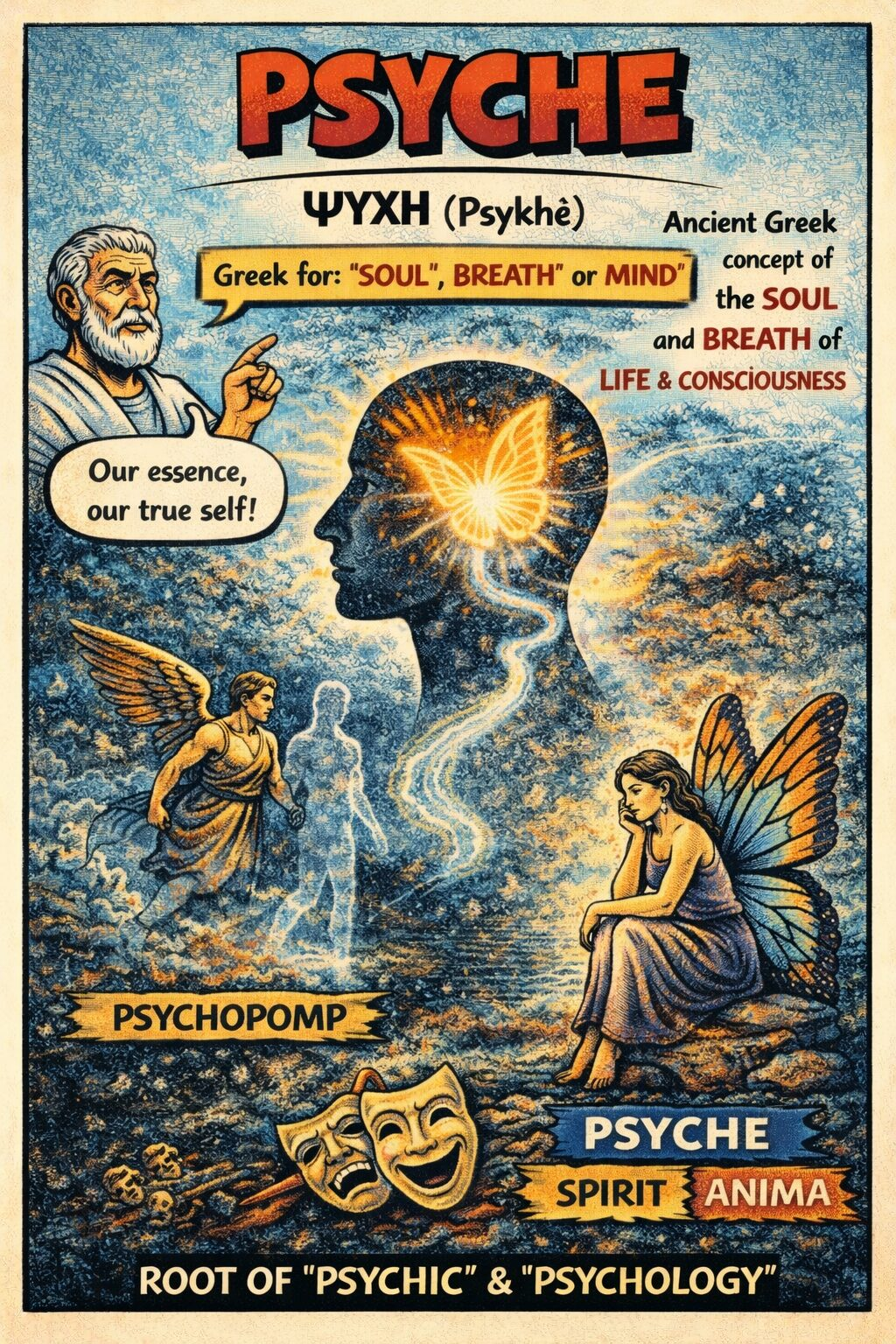
In ancient Greek, psyche meant “breath” or “soul,” later expanding to mean the mind or life-force. It represented the essence of life that departs the body at death. By classical times, it encompassed the seat of thought and emotion. This term forms the root of psychology (“study of the psyche”). It reflects the Greek concept of the soul as the animated mind which underpins the very name of modern psychology. Angels, invisible friends, and the ferryman Charon of the River Styx are examples of “psychopomps”. Not only will they transport people through the afterlife, but through other chaotic transitions.

Νοῦς (Noûs) – Nous
Greek psychological term “nous” denotes the intellect or rational mind – the faculty for understanding truth. For philosophers like Aristotle, “nous” was the highest, most innate form of cognition. This is distinct from sense perception and imagination, enabling one to grasp reality and first principles. Colloquially, even today “nous” connotes “good sense” in British English. The concept of “nous” as intuitive intellect foreshadows modern ideas of insight or common sense. It shows our faculty for perceiving truth beyond empirical data.

Θυμός (Thymós) – Thymos
Thymos in Greek conveys “spiritedness” – the element of the psyche responsible for emotions like anger, pride, and courage. In Plato’s tripartite model of the soul, thymos is the fiery intermediate part that loves honor and victory. Its mediation between reason and base desires connected righteous anger with the will to fight injustice. Today, though we don’t use thymos as a term, the idea of a passionate, honor-driven part of personality still survives. Its notions of spirited temperament underline the human need for recognition and dignity.

Πάθος (Páthos) – Pathos
Pathos originally meant “experience” or “suffering” and came to refer to emotional feeling. Aristotle used pathos for the emotions that a speaker can evoke in rhetoric. The word survives in English to denote an evocation of pity or sadness (e.g. “a story full of pathos”). Greek pathos also yields empathy, sympathy, apathy, etc. – empathy meaning in-feeling, and apathy meaning absence of passion. The Greek psychological insight that intense passions (pathē) can overpower reason is a cornerstone of our modern understanding. Pathos gives way to emotional bias and affective influence on judgment.

Ἦθος (Ēthos) – Ethos.
The Greek psychological term ēthos means “character” or “habitual character”. For Aristotle, ethos described a person’s character, especially as balanced between passions and prudence. It also referred to the persuasive appeal of the speaker’s character in rhetoric. Ethos is the root of ethics – underscoring that for the Greeks, morality was grounded in one’s character and habits. In modern psychology, while ethos isn’t a technical term, the focus on character and personality traits (and how consistent habits shape behavior) owes much to this Greek concept of ingrained character.

Φρόνησις (Phrónēsis) – Phronesis
This term denotes “practical wisdom” or prudence – the ability to govern oneself through sound judgment . Aristotle heralded phronesis as an intellectual virtue: the knack for navigating complex human situations to do good and live well. To the Greeks, phronesis meant knowing the right action in the right moment, tied to virtue and the flourishing life . While not used in everyday psychology, phronesis underlies modern concepts of wisdom, social intelligence, and the idea that true intelligence includes knowing how to behave virtuously and effectively in real life.

Διάνοια (Diánoia) – Dianoia
Literally “through-thought,” dianoia refers to discursive, step-by-step reasoning. Plato, in his analogy of the divided line, used dianoia to describe the mode of thinking involved in mathematics and logical inquiry – a level of understanding below intuitive nous. Dianoia is Greek psycho-analytical thought that uses hypotheses and syllogisms, contrasted with noesis (direct insight of higher truths) . This nuanced view of cognition – distinguishing logical reasoning from intuitive insight – presages modern distinctions between analytical thought (methodical, explicit reasoning) and intuitive thought.

Ἐπιστήμη (Epistḗmē) – Episteme.
Episteme in Greek psychological terms means true knowledge or understanding – often translated as “scientific knowledge” . It signifies knowledge that is certain and based on reasoned proof, as opposed to mere belief (doxa) . Plato and Aristotle both contrasted episteme (knowledge of eternal truths or principles) with doxa (opinion based on appearances). This gave rise to epistemology, the modern philosophical inquiry into knowledge. In psychology, the influence is indirect but crucial: the scientific method itself, striving for justified true belief (a very episteme concept), reflects the Greek insistence on moving from subjective opinion to verifiable knowledge.

Δόξα (Dóxa) – Doxa.
Doxa means “opinion,” “belief,” or common expectation . Greek psycho-philosophical thinkers like Plato treated doxa as the lowest grade of cognition – our flawed, perception-based beliefs about the world, which may or may not be true. Doxa was to be overcome by episteme (genuine knowledge) . In modern terms, we might relate doxa to subjective assumptions or popular beliefs (e.g. folk psychology) which can be incorrect. The doxa/episteme distinction survives in the scientific attitude of skepticism toward mere opinion. It also lives on in the word orthodox (“correct belief”) – implying some opinions can be more true than others.

Γνῶσις (Gnôsis) – Gnosis.
Gnosis is the Greek psychological word for “knowledge” in the sense of personal, inner knowledge . It often implied a deeper insight – for example, mystical or esoteric knowledge in the context of Gnostic philosophies . The term isn’t used in clinical psychology, but its legacy is felt in words like diagnosis (“through-knowledge”) and agnosia (“not knowing,” used for neurological inability to recognize things). The ancient notion of gnosis as insight (sometimes divine or self-knowledge) informs modern ideas that there are different ways of knowing – cognitive (factual) vs. experiential (insightful). It’s a reminder that beyond objective knowledge (episteme), personal understanding (gnosis) plays a role in areas like therapy (e.g. gaining insight into oneself).

Μανία (Manía) – Mania.
The Greek mania means “madness” or “frenzy,” a state of being “beside oneself” with obsession or excitement . The term encompassed various forms of madness – from harmful insanity to divinely inspired frenzies (as in Socrates’ idea of theia mania, divine madness in love or art). In modern psychology, mania is a clinical term (e.g. in bipolar disorder) describing a state of euphoric, overactive, and delusional excitement. The continuity is direct: when we say someone is “manic” or talk about a “manic episode,” we are using the same word the Greeks used for uncontrolled mental excitement. The idea that extreme highs (euphoria, hyperactivity) are a form of madness has been recognized since antiquity .

Ὑστερία (Hystería) – Hysteria.
Hysteria comes from Greek hystera (“womb”), reflecting the ancient belief that many emotional disorders in women were caused by a wandering uterus . Greek physicians like Hippocrates described “hysterical suffocation” and prescribed marriage or scents to lure the womb back to position. The term hysteria stuck for millennia – by the 19th century it referred to a constellation of anxiety and somatic symptoms (often diagnosed in women). Freud famously studied hysteria in his early work. Though modern medicine has discarded the sexist womb theory, the word persists in colloquial use (“hysterical”) and its Greek origin starkly illustrates how early misconceptions (a back door from Greek medicine) influenced the path of psychology .

Μελαγχολία (Melancholía) – Melancholia.
This Greek psychological term means “black bile” – melas (black) + cholē (bile) . According to ancient humoral theory, an excess of black bile produced a melancholic temperament. Hippocrates and Galen described melancholia as a specific mental illness characterized by prolonged fear, sadness, and even delusions . The concept evolved through the ages: in medieval times melancholia was linked to acedia or sloth; in Renaissance thought it became tied to artistic genius. In 19th-century psychiatry, “melancholia” was the standard term for what we now call depression . Modern psychology, in moving from “melancholic” to “depressive,” has moved away from the literal bile theory, but the idea that a biochemical imbalance can affect mood has ironic resonance with the old black-bile notion. And we still describe pensive sadness as melancholy, keeping this Greek legacy alive.

Ἀταραξία (Ataraxía) – Ataraxia.
Ataraxia is Greek for “not disturbed” – a state of profound calm and trouble-free tranquility . Hellenistic philosophies prized ataraxia: Epicureans sought it as freedom from fear and pain, Stoics aligned it with rational tranquility, and Skeptics saw it as the outcome of suspending judgment. An ancient sage with ataraxia would feel unruffled by externals. Today, while we don’t use the word ataraxia, the concept appears in ideas of inner peace, equanimity, and the stress-free mind. Techniques like mindfulness meditation aim at something very akin to ataraxia. This Greek ideal of robust equanimity (a mind undisturbed by anxiety) continues to inform modern pursuits of mental well-being .

Κάθαρσις (Kátharsis) – Catharsis.
In Greek katharsis meant “cleansing” or “purification,” used in religious and medical contexts for purging impurities . Aristotle famously applied it to the emotional realm in his Poetics: tragedy, he argued, causes an audience to experience a purging or release (catharsis) of pity and fear, leaving them relieved and enlightened. The term was resurrected by Freud and Breuer in the 1890s to describe the therapeutic release of pent-up emotions – as when a patient finally expresses a repressed trauma and finds relief . Catharsis remains a common concept (e.g. “crying was cathartic” or cathartic art), encapsulating the Greek insight that emotional expression can be healing. It’s a vivid example of an ancient aesthetic theory directly influencing psychological therapy terminology.

Φόβος (Phóbos) – Phobos (Phobia).
Phobos is the Greek word for “fear.” In mythology Phobos was personified as the god of fear, son of Ares, often accompanying his father into battle to sow terror. The English -phobia comes straight from Greek phobos . The Greeks used the -phobia suffix too (e.g. hydrophobia for fear of water). In modern psychology, phobia denotes a pathological fear – an irrational, persistent fear of specific objects or situations. This is a direct through-line from Greek: what they identified as overwhelming fear, we clinicalize as a phobia. The enduring use of the term (e.g. arachnophobia, agoraphobia) demonstrates how Greek language provides a framework for classifying our anxieties .

Ἔρως (Érōs) – Eros.
Eros means “love” or “desire,” especially of the passionate, physical sort . In Greek philosophy, Eros also took on a broader meaning of the soul’s desire for beauty and transcendence (as in Plato’s Symposium). Freud famously adopted Eros to name the life instinct – the ensemble of drives toward love, creativity, sexual generation, and everything that sustains life . Thus, in psychoanalysis Eros (life-drive) eternally opposes Thanatos (death-drive). The term erotic (from eros) also entered modern vocabulary for sexual love. The journey of eros from a winged Greek god to a Freudian instinct exemplifies the direct importation of Greek concepts to explain human motivation, linking ancient notions of passion to modern libido theory.

Θάνατος (Thánatos) – Thanatos.
Thanatos is the Greek personification of Death – in myth, a somber winged figure or spirit who gently ferried humans to the underworld. The name simply means “death” in Greek. Freud’s followers later used Thanatos to label the hypothesized “death drive” – an instinctual pull toward aggression, destruction, and a return to inorganic quiescence . Freud in Beyond the Pleasure Principle posited that beyond Eros (the life instinct) there was a contrary drive toward death, explaining repetition compulsion and aggression . Calling it Thanatos explicitly linked this modern idea to Greek mythology. While the death drive remains controversial in psychology, the term endures in discussions of human aggression and self-destructive tendencies. It’s a striking case of a Greek mythic name directly shaping psychological jargon, offering a poetic shorthand for humanity’s darker impulses.

Σωφροσύνη (Sōphrosýnē) – Sophrosyne.
This Greek word is often translated as “temperance” or “moderation,” but its literal meaning is “soundness of mind” or “prudence.” Sophrosyne implied a well-balanced mind that governs desires – self-control, restraint, and inner harmony . The Greeks considered it a cardinal virtue (inscribed at Apollo’s temple in Delphi). Someone with sophrosyne has mastery over their impulses and lives in due measure. Although the term fell out of use, the concept lives on in the psychological emphasis on self-regulation and impulse control. The ability to delay gratification, maintain self-discipline, and avoid extremes – all central to emotional intelligence and healthy personality – resonate with the ancient ideal of sophrosyne. In a way, CBT’s goal of cultivating balanced, reality-based thinking echoes sophrosyne’s “sound-mindedness”.

Εὐδαιμονία (Eudaimonía) – Eudaimonia.
Eudaimonia in Greek means “having a good daimon (spirit)” – often translated as happiness, well-being, or flourishing . Rather than momentary joy, it signified a lasting state of fulfillment. Aristotle famously defined eudaimonia as the highest human good – essentially a life of virtuous activity and excellence that realizes one’s true potentials . This idea of happiness as flourishing through virtue (and not just pleasure) has strongly influenced positive psychology. Psychologists today distinguish eudaimonic well-being (a sense of meaning, growth, and authenticity in life) from hedonic well-being (positive feelings and pleasure) . The fact that we revive the term eudaimonic to discuss deeper life satisfaction shows a conscious return to Greek insights. It’s a reminder that for a life to be truly “happy” (eudaimon), it must be lived in accordance with one’s values and talents – a concept first articulated over two millennia ago.

Ἡδονή (Hēdonḗ) – Hedone.
Hēdonē is the Greek word for “pleasure.” It’s the root of hedonism, the philosophy that pleasure is the highest good . The Cyrenaics and Epicureans made serious study of hedone: what it is, which pleasures are better, and how to attain a life of enduring (primarily mental) pleasure. Modern psychology references this in the concept of hedonic adaptation (our tendency to acclimate to pleasures) and hedonic well-being (happiness as frequent positive emotion) . We also use the term hedonic treadmill for the chase of pleasure. In naming these, we are channeling the Greek word directly. The enduring debate – pursue pleasure or pursue virtue? hedonic vs eudaimonic happiness – is essentially the same debate ancient Greek ethicists had. Hedone as a concept helps illuminate the “feel-good” aspect of the mind, from instant gratification to long-term contentment.

Νάρκισσος (Nárkissos) – Narcissism.
Narcissus in Greek myth was the beautiful youth who became entranced by his own reflection and wasted away; a flower (the narcissus) sprang up where he died . The term narcissism – denoting excessive self-love and self-centeredness – comes from this tale . Freud introduced “narcissism” into psychology to describe a stage of infant development and certain pathological traits (later Narcissistic Personality Disorder). The myth serves as a perfect metaphor for pathological self-absorption, and its direct adoption into clinical vocabulary shows the power of Greek storytelling to capture psychological patterns. When we call someone a narcissist, we invoke the image of Narcissus at the pool – a mind turned inward, unable to love others. It’s a prime example of an ancient cultural concept (the danger of egotism) being formalized in modern personality theory .

Ὕπνος (Hýpnos) – Hypnos (Hypnosis).
Hypnos was the Greek god of Sleep – depicted as a gentle winged figure. The English term hypnosis was coined (by Dr. James Braid in 1843) from Hypnos’ name, to highlight the sleep-like state of a hypnotized person. Braid initially called it “neuro-hypnotism” (“nervous sleep”) after the Greek deity and then shortened it to hypnotism. Although hypnosis is not actually sleep, the metaphor of a slumber induced on command was compelling. The very choice of name shows 19th-century scientists reaching into the classical lexicon to describe a novel mental phenomenon. Hypnosis and hypnotherapy today still carry that root – every time we use the word, we’re speaking Greek. It’s a reminder of how ancient mythological figures (Hypnos, in this case) have become linguistic fixtures in scientific discourse .

Ἀπάθεια (Apátheia) – Apatheia.
Apatheia means “without passion” (from a- “without” + pathos “suffering/passion”) . In Stoic philosophy, it was the ideal mental state of complete equanimity – being unmoved by destructive emotions or outside events. Achieving apatheia did not mean being numb or unfeeling; it meant having such wisdom and self-control that one no longer experiences irrational passions, only reasonable reactions . The term is the ancestor of modern “apathy,” but note the shift in flavor: today apathy implies a problematic lack of feeling or motivation, whereas apatheia was a positive achievement of inner peace .
The Christian monastic tradition also adopted apatheia to describe holy dispassion. In modern therapy, ideas akin to apatheia surface in practices that teach mindful detachment or distress tolerance – learning to observe one’s emotions without being controlled by them. The subtle change from laudable Stoic calm to clinical apathy marks how context can flip a concept’s value, yet the root idea of freedom from passion remains relevant in discussions of emotional regulation.

Τραῦμα (Traûma) – Trauma.
Trauma is the Greek word for “wound” . In ancient usage it referred to physical injuries. The term was carried into medicine (e.g. traumatology for wound surgery). Only in the late 19th and 20th centuries did trauma also come to signify psychological wounds – the lasting mental harm from a shocking or painful experience. This extension from body to mind was natural: severe emotional shocks were seen analogously to physical blows. Today trauma is a core concept in psychology and psychiatry (post-traumatic stress, trauma-informed therapy, etc.), illustrating how a simple Greek word for injury has evolved to frame our understanding of emotional injury . The Greek origin is a potent metaphor – just as the body can be wounded and need healing, so too can the psyche be traumatized and require care.
Conclusion
Each of these terms – from psyche and nous to trauma – acts as a ‘back door’ into the history of psychological ideas. They show that much of how we conceptualize the mind, emotions, and behavior today stands on foundations laid by ancient Greek thinkers, filtered through centuries of interpretation. The Greek language, with its rich vocabulary for inner life, has been a generous donor to psychology’s lexicon, carrying forward insights (and occasional misconceptions) that still spark exploration into the human condition.
Sources:
https://plato.stanford.edu/entries/ancient-soul/
https://psychology.town/general/evolution-psychology-ancient-philosophy-modern-science/
https://blog.apaonline.org/2019/02/21/why-ancient-greek-psychology-is-still-valuable-today/
https://en.wikipedia.org/wiki/Psychology
Related articles:
https://spiritualdepthmovement.com/consciousness-map/
https://spiritualdepthmovement.com/souls-spirits-and-sentience-under-the-new-machine-mind/